

In the narrative of Chinese tennis, clay courts represent both the pinnacle of achievement and the starkest bottleneck. Li Na clinched Asia’s first Grand Slam title on the red clay of Roland Garros in 2014, and Zheng Qinwen repeated the feat on the same surface at the 2024 Paris Olympics.
Despite these historic moments, China’s tennis development has long been dominated by hard courts. Clay and grass courts, due to high construction costs, complex maintenance, and limited public awareness, remain concentrated in a handful of high-end clubs. The barriers to entry are high, and the complete industry chain—from facilities and training to tournaments—is lacking. Red clay tennis in China has fallen into an “elite, niche” development trap, stalling widespread popularization.
Against this backdrop, Huzhou has launched an unconventional experiment. 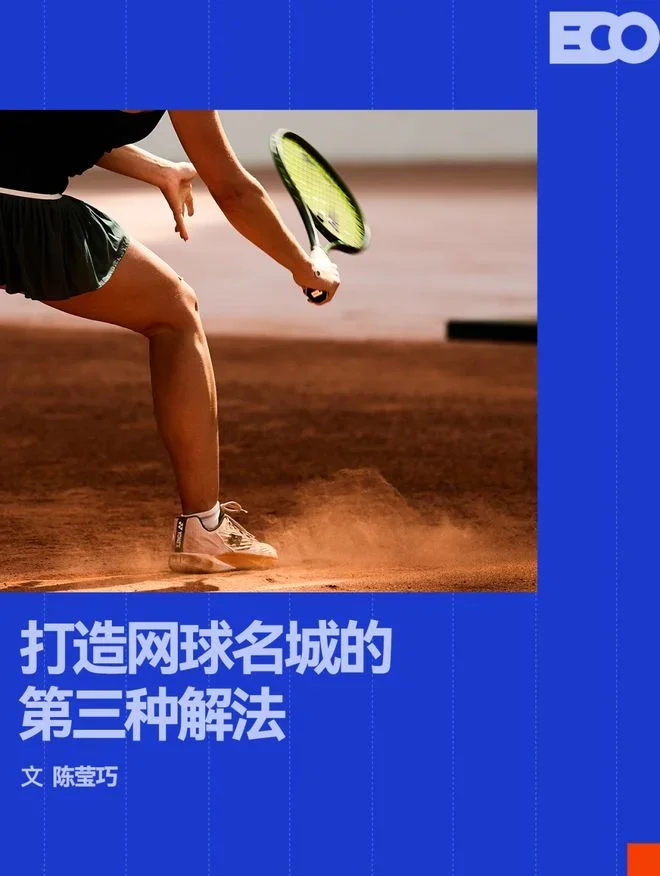 This water town in the Jiangnan region, which produces no red clay and has no native top professional stars, unveiled China’s largest red clay tennis center in March 2025. The facility features 14 French Open-standard clay courts, 4 hard courts, a 5,300-seat main stadium, and attracted tennis legends Andre Agassi and Steffi Graf for the opening ceremony.
The strategic foresight and star power underscore Huzhou’s determination to become a red clay tennis hub, offering a key model for the popularization and industrialization of the surface in China. According to Zhao Yongxu, Deputy Party Secretary of the Wuxing District State-owned Capital Group, Huzhou, located in the core of the Yangtze River Delta, conducted in-depth research on the tennis industry landscape of surrounding cities before planning the center. The decision was to focus on differentiated development, targeting the gap in domestic red clay tournaments and professional courts. By building a high-standard facility, Huzhou aims to host top-level clay events.
A critical step was the recalibration of the 2026 WTA 125 Huzhou International Women’s Tennis Open. Originally scheduled for September during the Asian swing, it was moved to April, aligning with the European clay court season. This shift positions the tournament as a valuable warm-up option for Asian players ranked 100–300, offering a “low travel cost, high ranking points” opportunity without having to travel to Europe.  The move also leverages the “May Day” holiday traffic and the uniqueness of China’s largest clay center.
Regarding long-term operation, Zhao noted that tennis has strong social attributes. Huzhou is using red clay tennis as a bridge to connect with diverse industries—serving corporate, government, university, and amateur events. The center is positioned as a “scenario-based investment platform and new business social venue,” with a local enterprise, Dadongwu, as the title sponsor. By the first quarter of 2026, the venue had already achieved positive revenue, thanks to a diversified business model that includes tennis education, commercial partnerships, and cross-industry collaborations such as new product launches for sports brands, automobiles, and apparel.
The push for grassroots tennis has also accelerated. Since October 2025, the center offers free entry every Wednesday (one hour per person). A multi-tier system of amateur red clay tournaments—including the Yangtze River Delta team invitational, Huzhou Open, Tennis123分级赛, a women’s clay program, and national junior rankings—has brought red clay tennis into public life.
Looking ahead, Huzhou is taking a measured approach: focusing on delivering a high-quality WTA 125 event, refining organizational capabilities, and upgrading service standards, with the goal of making red clay tennis a signature city brand. From having the largest clay court complex in China to becoming a stop on the global red clay tour, Huzhou is accelerating its breakout. By adopting differentiation and distinctive operations, it is using professional red clay tournaments to break down public perception barriers, integrating resources to connect professional and amateur tennis, and gradually evolving into an engine for city branding and industrial development. This “Huzhou solution” not only carves out a niche for Chinese tennis in the global tournament landscape but also offers a fresh model for other cities.
